Kewal Singh Dhillon Barnala · Punjab

Contributions

Six areas of documented work, each set out in the same terms: the context it arose in, what was actually done, why it mattered, and where it stands today.

Areas examined
Six
Primary constituency
Barnala, Punjab
Period
1979 – present
Method
Only claims traceable to published sources or public records

A note on method

Political biographies tend to inflate. This page does the opposite: it lists only what can be traced to reporting, to Election Commission records, or to his own published constituency account — and it says which of the three, so a reader can weigh it.

Where a figure exists it is given. Where none exists, none is invented. Several of the local details below appear only in his own constituency writing; those are marked as such rather than presented as independently verified.

01 Administrative reform

A district restored to Barnala

The single act most consistently placed at the head of his public record — and the one with the widest daily effect on people who never voted for him.

Context

Barnala had been a district headquarters under PEPSU, the Patiala and East Punjab States Union. When PEPSU was merged into Punjab and the state was later reorganised, Barnala lost that status and was folded into Sangrur. Residents travelled to Sangrur for district administration, courts and records for decades afterwards.

What was done

A sustained campaign for the restoration of district status, pressed through the state government. Barnala was constituted as a district on 19 November 2006 — before Dhillon held elected office, and during the period he served as a Congress organiser in the area.

Significance

District status is not symbolic. It brings a Deputy Commissioner, a Superintendent of Police, a district court complex, treasury and revenue offices, and a separate line in the state’s budgetary and planning allocations.

Where it stands

Barnala remains a district of Punjab. Its administrative apparatus, its own police district and its position in state planning all date from that 2006 notification.
02 Education access

Courses where there were none

Two interventions, forty years apart in effect: a vocational course in the town, and a teacher-training college in the village.

Context

In 1979 Barnala had a degree college but no vocational or professional stream. Rural students who wanted a technical qualification had to leave the district, and many therefore did not acquire one.

What was done

In the year of his return from abroad he donated ₹51,000 to S.D. College, Barnala to establish D-Pharmacy classes. Separately, he secured a B.Ed. college in his native Tallewal, intended for girls from the surrounding villages.

Significance

The pharmacy diploma opened a defined employment route locally. The Tallewal college addressed a specific constraint: rural families frequently would not permit daughters to travel long distances for training, so proximity, not merely availability, determined whether girls trained as teachers at all.

Where it stands

Both institutions are recorded in his constituency account of his own work. The ₹51,000 donation predates his first political office by seven years, which places it outside the usual pattern of election-cycle philanthropy.

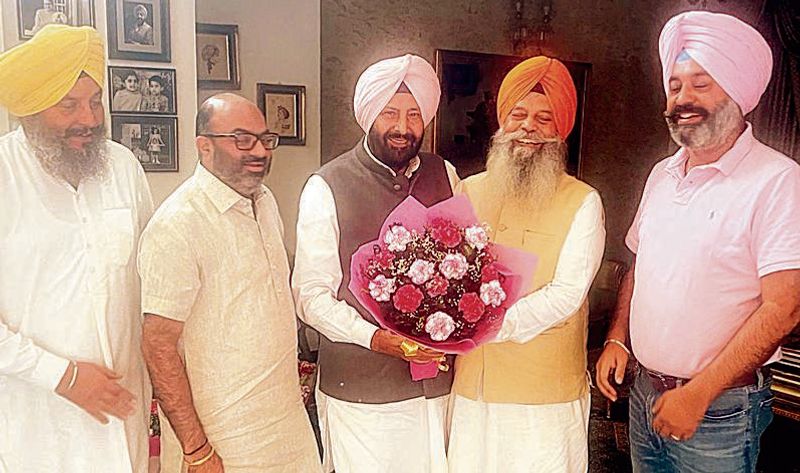
Kewal Singh Dhillon meeting a group of community and religious figures at an indoor gathering
Meeting community figures — the constituency work that sits behind most of the entries on this page.

03 Women’s livelihoods

Twenty-five stitching centres

A trust in his father’s name, and one of the few home-compatible trades open to women in rural Punjab.

Context

Female workforce participation in rural Punjab is low, and social constraints on women travelling for work are significant. Tailoring is one of the few skilled trades that can be practised from home and that generates independent income.

What was done

He established a trust in the name of his father, Sajjan Singh, which has operated more than twenty-five stitching centres. Women who complete the course receive both a certificate and a sewing machine.

Significance

The sewing machine is the operative detail. Training without equipment leaves a graduate dependent on borrowing or hiring; supplying the machine converts the certificate into an immediately usable capacity.

Where it stands

Recorded in his constituency account. No independent audit of the centres’ current operation is publicly available, and none is claimed here.

04 Rural infrastructure

Roads, bridges, grids and water

The bulk of the constituency record from the two Assembly terms between 2007 and 2017.

Context

Barnala sits on the road and rail corridors that link Ludhiana with Bathinda and the southern Malwa districts. Level crossings, unmetalled village links and unreliable three-phase power were the practical constraints on both farming and small industry.

What was done

Reconstruction of the Ludhiana–Barnala, Bajakhana–Barnala and Jaraon–Barnala roads; approximately eighteen kilometres of village link roads; four railway over-bridges sanctioned; electricity grids at Karamgarh and Tallewal; submersible pumps personally funded to supply drinking water to poorer households.

Significance

Railway over-bridges in particular change the economics of a mandi town: they remove the waiting time at level crossings that constrains the movement of grain trucks during procurement season.

Where it stands

Also recorded is more than ₹1 crore in housing grants for below-poverty-line residents and ₹2.5 crore distributed to panchayats. These figures come from his own constituency account rather than from an independent audit.

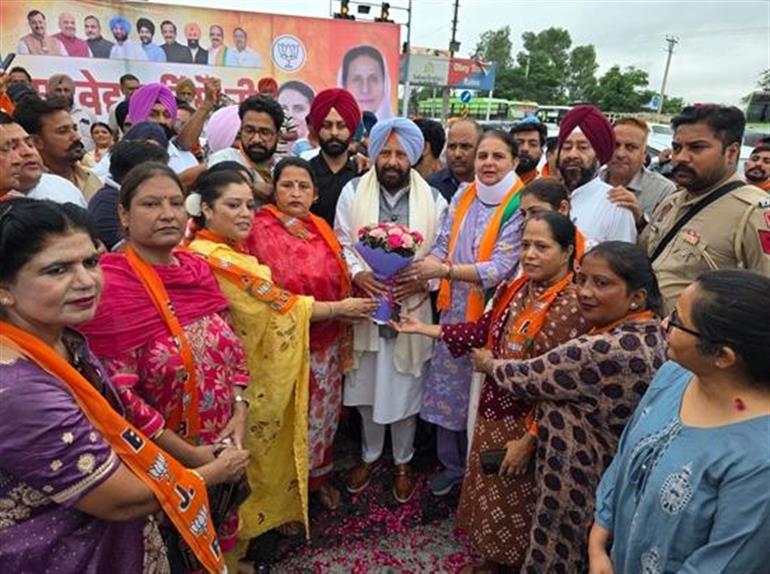
A large group of party workers, many of them women, gathered at a roadside welcome programme in Punjab
A roadside welcome programme in Punjab — the form most rural political contact takes in the state.

05 Legislative advocacy

What he raised in the Assembly

Four matters from his two terms, recorded in his own account of his work in the Punjab Vidhan Sabha.

Farmer distress

He raised the question of farmer suicides in the House and demanded the production of the survey reports prepared by Punjab Agricultural University, Ludhiana — an attempt to force official data into the record rather than argue from anecdote.

Municipal finances

He challenged in the Assembly a proposal to write off a municipal loan of ₹100 crore.

Public space

He opposed the construction of offices on Bhagat Singh Park in Barnala, keeping the public ground intact — a small matter of the kind that determines whether a town keeps its open space.

Market infrastructure

He secured ₹28.34 lakh for the flooring of the grain market at Bhaini Mehraj — unglamorous, and directly consequential for how much of a harvest survives handling.

06 Party organisation

Building and leading organisations

Four decades of organisational office across two parties, ending — so far — in a state presidency.

Context

Punjab’s party organisations are built on region and community as much as on ideology. Malwa, rural and predominantly Jat Sikh, decides state governments; a party without leadership there does not govern Punjab.

What was done

President of the Punjab Youth Congress from 1986; senior vice-president of the Punjab Pradesh Congress Committee during his second Assembly term; Congress observer for four states in 2014; vice-president of the BJP’s Punjab unit from 2022; President of the BJP’s Punjab unit from 3 June 2026.

Significance

His appointment made him the first Jat Sikh to head the BJP’s Punjab unit. For a party whose Punjab base has historically been urban and Hindu-majority, that is a structural change rather than a personnel one.

Where it stands

He took charge naming farmers’ welfare, youth employment and the state’s development as his priorities, with the 2027 Punjab Assembly election as the test.

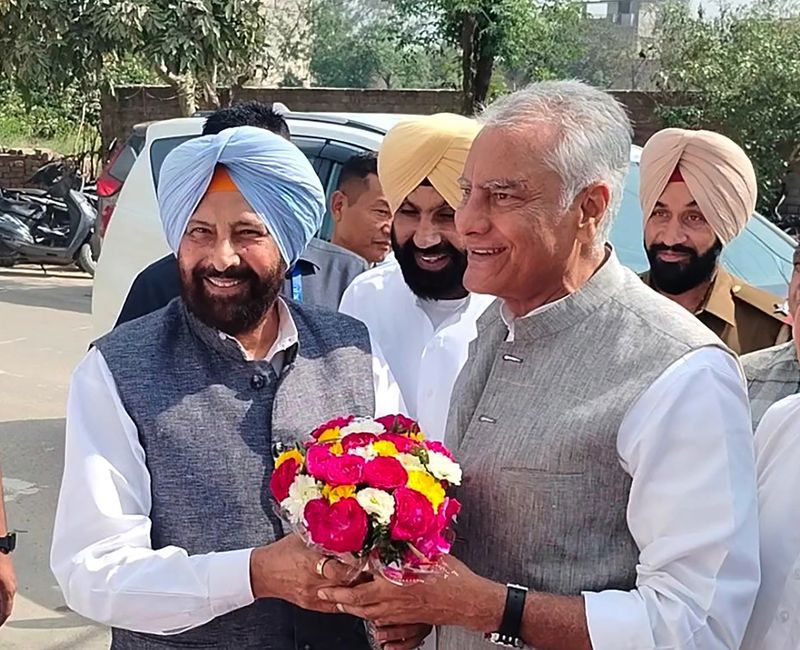
Kewal Singh Dhillon greeting a senior party colleague with a bouquet outside a public venue
Party outreach in the constituency — the organisational work that underlies every entry in this section.

Continue

See how these contributions sit in sequence.